With Intellectual Property Law: Protecting Your Inventions in the Age of AI at the forefront, this paragraph opens a window to an amazing start and intrigue, inviting readers to embark on a storytelling journey filled with unexpected twists and insights.
The content of the second paragraph that provides descriptive and clear information about the topic
Overview of Intellectual Property Law
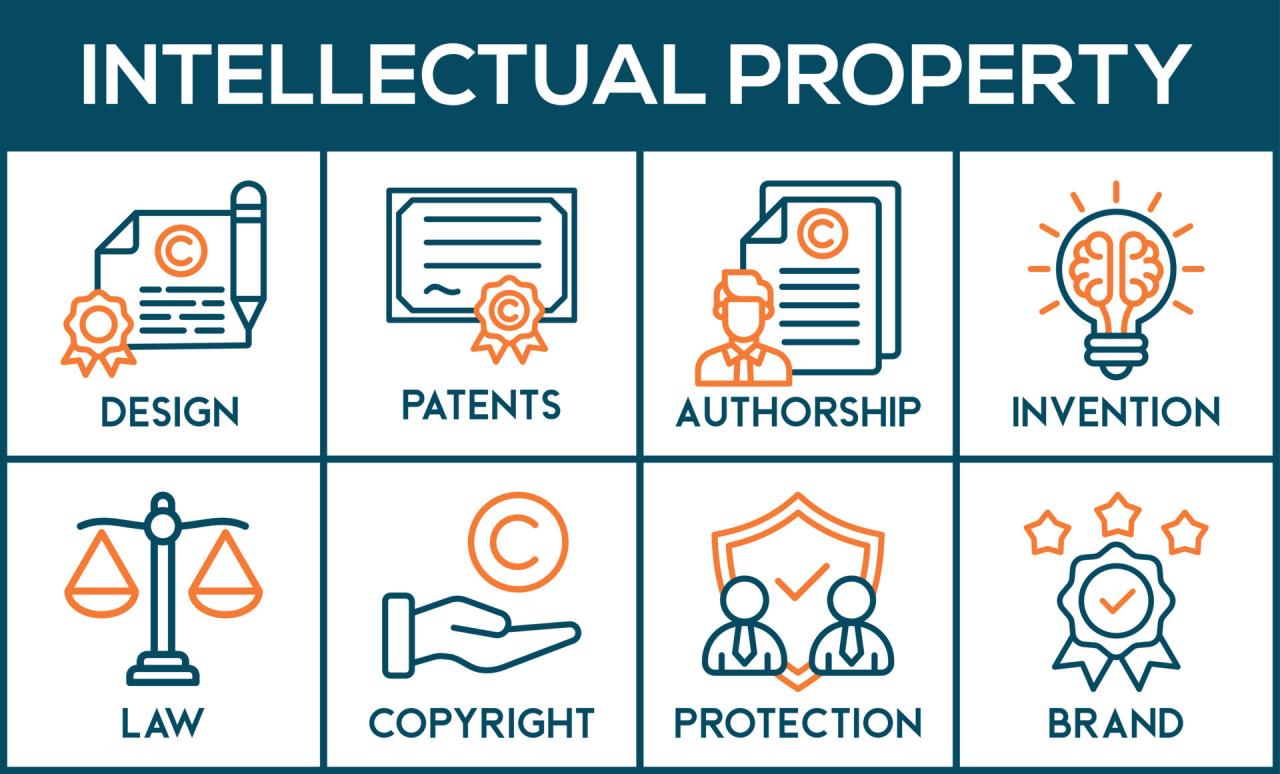
Intellectual property law plays a crucial role in safeguarding inventions and creations, providing creators with the legal framework to protect their innovative work from unauthorized use or reproduction.
Types of Intellectual Property Rights
- Patents: Grants inventors exclusive rights to their inventions, preventing others from making, using, or selling the patented product without permission.
- Trademarks: Protects brand names, logos, and symbols used to identify goods or services, ensuring consumers can distinguish between different products in the market.
- Copyrights: Safeguards original works of authorship, such as literary, artistic, and musical creations, giving creators control over how their work is reproduced, distributed, and performed.
- Trade Secrets: Confidential information that provides a competitive advantage to a business, such as formulas, processes, or customer lists, protected from disclosure or unauthorized use.
Role of Intellectual Property Law in Fostering Innovation
Intellectual property law serves as a catalyst for innovation and creativity in the era of AI by incentivizing inventors and creators to develop new technologies and artistic works. It promotes a competitive environment that encourages investment in research and development, leading to advancements in various fields. With the protection offered by intellectual property rights, individuals and businesses are motivated to continue pushing the boundaries of knowledge and expertise, driving progress and growth in society.
Patent Protection for AI Inventions
When it comes to protecting AI inventions, obtaining a patent is crucial to safeguarding your intellectual property. This process involves a detailed application that Artikels the unique aspects of your AI technology and demonstrates its novelty, utility, and non-obviousness.
Process of Obtaining a Patent for AI-related Inventions
- Conduct a thorough search to ensure your AI invention is truly novel and not already patented by someone else.
- Prepare a detailed patent application that clearly describes the technical aspects and functionalities of your AI technology.
- Submit your application to the relevant patent office and undergo examination to determine if your invention meets the criteria for patentability.
- If approved, your AI invention will be granted a patent, providing you with exclusive rights to use and commercialize it for a set period of time.
Challenges of Patenting AI Inventions vs. Traditional Inventions
- One of the main challenges with patenting AI inventions is the complex nature of these technologies, which can make it difficult to clearly define their boundaries and novelty.
- AI inventions often involve algorithms and machine learning models, which may not fit neatly into traditional patent categories, requiring innovative approaches to protect them.
- Another challenge is the rapid pace of innovation in the field of AI, making it challenging to keep up with new developments and ensure that your patent remains relevant and enforceable.
Examples of Successful Patent Applications for AI Technologies
- IBM's patent for a system that uses AI to predict when equipment failures are likely to occur, allowing for proactive maintenance and cost savings.
- Google's patent for an AI-powered language translation system that can accurately translate between multiple languages in real-time.
- Amazon's patent for an AI-driven recommendation engine that analyzes user behavior to provide personalized product recommendations, leading to increased sales and customer satisfaction.
Copyright Protection in the Age of AI
In the realm of intellectual property law, copyright protection plays a crucial role in safeguarding creative works. With the rise of artificial intelligence (AI) technology, the application of copyright law to AI-generated content has become a complex and evolving area.
AI-Generated Content and Copyright Law
AI has the ability to autonomously generate content such as music, art, literature, and other creative works. In the context of copyright law, the main question arises: who owns the copyright to works created by AI?
- AI as a Tool: Copyright law typically grants ownership to the human creator of a work. However, in the case of AI-generated content, the lack of human authorship complicates the determination of copyright ownership.
- Legal Challenges: The absence of a human creator raises challenges in establishing copyright ownership and may require legislative updates to address the implications of AI on copyright law.
Implications for Copyright Ownership
The emergence of AI technology raises significant implications for copyright ownership and infringement:
- Ownership Disputes: The lack of clear guidelines on copyright ownership of AI-generated works can lead to disputes between developers, users, and AI systems.
- New Creators: AI's role in content creation blurs the line between human and machine creators, challenging traditional notions of authorship and copyright ownership.
Protecting AI-Generated Works under Copyright Law
Despite the challenges, there are strategies to protect AI-generated works under copyright law:
- Contractual Agreements: Developers and users can establish clear agreements regarding copyright ownership and usage rights for AI-generated content.
- Derivative Works: Copyright protection may apply to derivative works based on AI-generated content, providing a level of protection for the creative output.
Trade Secrets and AI Technology
Trade secrets play a crucial role in protecting valuable information and innovations in the AI industry. These are confidential business practices, processes, or information that provide a competitive advantage and are not publicly known.
Defining Trade Secrets and their Relevance to AI Innovations
In the realm of AI technology, trade secrets can encompass algorithms, datasets, training methodologies, and other proprietary information that power AI systems. By keeping these aspects confidential, companies can maintain a competitive edge in the market and safeguard their innovations from being replicated by competitors.
Strategies for Protecting Trade Secrets in the AI Industry
- Implement strict access controls: Limiting access to sensitive information within the organization can help prevent unauthorized disclosure.
- Use non-disclosure agreements (NDAs): Having employees, partners, and vendors sign NDAs can legally bind them to maintain confidentiality.
- Secure data storage and transmission: Employ robust encryption methods to protect trade secrets when stored or shared electronically.
- Regularly update security protocols: As AI technology evolves, so should the security measures in place to safeguard trade secrets.
Balancing Knowledge Sharing and Trade Secret Protection
While sharing knowledge and insights can foster innovation and collaboration in the AI industry, it is essential to strike a balance between transparency and protecting trade secrets. Companies must carefully evaluate the risks and benefits of sharing information externally while ensuring that critical intellectual property remains confidential.
Final Conclusion
The content of the concluding paragraph that provides a summary and last thoughts in an engaging manner
Key Questions Answered
What are the different types of intellectual property rights?
The different types include patents, trademarks, copyrights, and trade secrets.
How does copyright law apply to AI-generated content?
Copyright law applies to AI-generated content similarly to other types of content, protecting the original works from unauthorized use.
What is the process of obtaining a patent for AI-related inventions?
The process involves filing a patent application with detailed descriptions of the invention's novelty and usefulness in the field of AI.